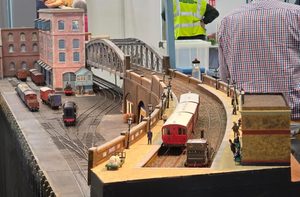
The name ‘Baddlesham‘ has now been selected for this new diorama
Some years ago, the club decided to construct a small Diorama layout. Member Jim May (our then carpenter) said he would cut the wood at his workshop, and that he would make it out of 4’ by 2’ plywood sheets. Jim had cut the wood, then a few months later he became very ill and sadly passed away, so the project never got finished.
Tim and I were asked could anything be done with the Diorama. I said the wood just needed gluing and screwing together, Tim said he would have a go at doing a small industrial scene. Before Tim started, I said the Diorama looked quite tall, we tried to put it across the back seat of his car, no it would not fit, so I had to cut it down from 24 inches in height to 21 inches, it would now fit, the Diorama size now 4 feet x 2 feet x 21inches.
Tim started to put something together, but we discovered two things. First the wood had warped while in storage – if you uncoupled a wagon at one end it would roll to the middle, Jim had not allowed for any cross/bracing underneath. Secondly you were limited to what you could do, basically just shunt a couple of wagons from the traverser onto the Diorama and back. Tim thought it needed something more, maybe add a narrow-gauge line, but that would have to wait as he was now involved with Queen Charlotte Dock.
The Diorama sat in storage for about a year. I then decided to add some cross/bracing underneath to give it more support, after which it has just sat there. Chris asked, was anything more going to be done to the Industrial scene, we said probably not. I said I had an idea, something different, and would put something to the committee. I drew out the plan shown below.
After Geoff’s excellent talk on Diorama’s, it got me thinking about an alternative to the small industrial layout, something with a bit more movement. I had been planning a small layout at home, and thought if I reduced the plan in size, could I present it as a working Diorama layout. The main trouble was I only had 4 feet (48inches) to work with, three Peco
points would take up 48 inches, that would leave no room for a head shunt or run around loop.
In one of Ian Rice’s books, he shows how to save space by using a sector plate to act as a point, this straight away gets rid of the point space, saving some 17 inches. I then thought if I mounted a removeable cassette on top of this sector plate that would make interesting operation, something which has not been done before. So, we would remove the traverser,
replace this with an up to 3-foot sector plate / cassette, we would then have a small layout that could fit on two 6 foot tables. I would have to reduce the height at the back of the Diorama, as suggested by Geoff, it is too high, and you can’t put your arm over to couple or uncouple stock. (Could we use Dingham couplings?)
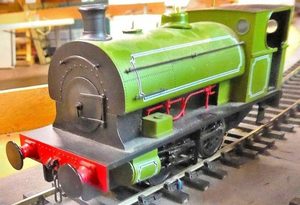
Operation would be DC or DCC, the 2 Peco points would be hand operated, by wire in tube. Stock would be small 0-6-0 or 2-4-0 locomotives, with small 4 or 6-wheel coaches, as per on QCD.
See plan below.
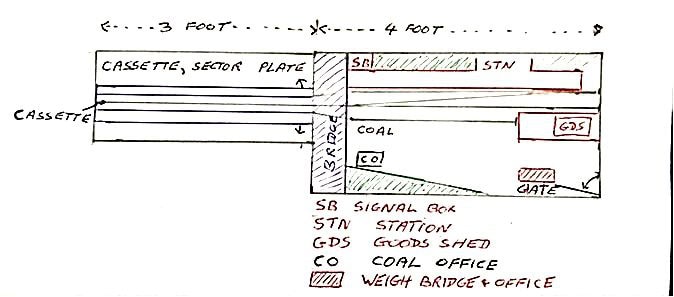
I mentioned to Chris that I would prepare a plan for you all to see. (Since drawing the plan, I have found I need to extend the Diorama by 4 inches, 2 inches at either end, this is to give clearance for the run around at the points, and extra space for the coaches to fit in the platform, I have also moved the signal box to next the station building).
It would not cost much, we have been donated 2 left hand Peco points and a bit of track, the wood for the cassette / sector plate we have in stock, so we just need to purchase a bit more wood and track.
I will leave this for members to think about.
Need to pick a name for the layout if it gets approval, Son of Sarre? One name put forward is Sarrson.
If any other member wants to put something forward about the Diorama, and take it on as a project, please speak to the committee, otherwise this is what I propose.
Our new diorama
As project leader for the diorama, I have been asked to pick a name, create a history etc. Now I know I am going to upset some of you, you all have your favourite railways and areas, but this is what I have come up with. Name The layout is entirely fictious, as will be the name. We meet at Badlesmere near Faversham, the first name I have picked is a made up from both places, so Badlesham. The second choice as it’s in the south near Kent / E Sussex border is Southmere. So, you pick, Badlesham or Southmere. History Researching the area there are a few sand and gravel pits. So, the line was built and opened in 1907 to serve the extraction from these pits, with a goods yard / depot at the end of the line. This yard later had a small platform built to facilitate a demand for a passenger service for the local village. Looking through the bridge at the end of the platform you may just see the line forking off to the left to serve the gravel pits. Gaining government approval, Colonel Stephens was approached by a consortium of business men led by Robert Brett, to build the line, but the Colonel was too busy with other projects, so he had to decline, although he did meet with Brett & Co to give some advice and ideas. After going out to contract, Messrs Joseph T Firbank built the line. The line became very busy in 1914, with the outbreak of the first world war, the army had purchased the manor house and land across the road from the goods yard to convert it into a military hospital, later convalescent centre, then again in 1939 it was converted back to a hospital. The line continued into the early 1960’s, the extraction of sand and gravel ceased in 1957, and the line is becoming non profitable and may close soon. Robert Brett first started work in 1884 for steam and traction engine maker and owner, George Felix Finn in Wincheap, Canterbury. He quickly worked his way up, learning the operation of a steam engine, then became departmental manager. Seeing a need for moving aggregates he formed his own company using railways. The Brett company has remained in family control, nowadays one of the largest aggregate companies in the UK.
The above is pure fiction except for the people and companies named. If any member wishes to add to the story of the line or correct me – (if this or that would not have happened), let me know. It also gives us the option to operate two periods 1930s with six or four wheeled coaches, or late 50s early 60s with later stock.
David Hopkins
Or even a Ford railbus?