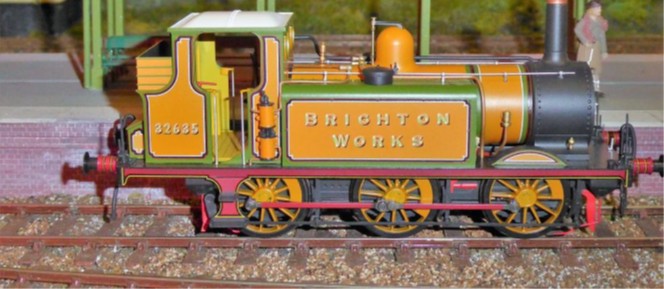
David L gave a very interesting and informative talk on the history of the London Brighton and South Coast Railway starting with the early days of the London & Croydon Railway and the London & Greenwich Railway and their eventual merging with the London & Brighton Railway in 1836 to form the LB&SCR. Brighton station was located in a very restricted site and large sections of the chalk cliff face had to be removed to make way for it. The original station building was built in the Italianate style and survived until 1973 although by then having been altered and added to over the years had rather lost its original sense of grandeur. David illustrated his talk with many early photographs with lots of interesting details. Of particular note was that when built the station was virtually surrounded by open countryside. In the early days of course horse travel was still the major means of transport and David’s photos showed the scale of movement at that time on the railway of large numbers of horse boxes and carriage wagons. At first there were a surprisingly large number of wagon turntables in use throughout the station complex although later photographs showed that these had all gone by the 1880s by which time the platforms had been lengthened as had the train shed. David also showed us photographs of the various stages of widening the bridge at New England Road and of the tunnel under the station giving access to the lower goods yard. The tunnel is still there today but used only for storage. There were also some weird and wonderful early signalling formations including at Montpelier Junction where the signals were mounted on the signal box roof. Despite being short of space, the train shed and the loco works were crammed into the same location, and we saw photographs of the very cramped Brighton motive power department and various photographs of old locomotives, including an experimental 0-6-2T which had coupling rods on only the rear four driving wheels. Another oddity was the LBSCR re-purposing of six-wheel coaches whereby two of them would be placed on a 54 foot bogie frame in a sort of cut and shut operation to form a new bogie coach. Trains arriving at Brighton in the early days would stop outside the station while ticket inspectors joined the train and inspected everybody’s tickets. Not surprisingly the delayed arrival was not appreciated by patrons. David finished off his talk with photographs from the Edwardian era, and it was interesting to see how the Brighton end of the LBSCR and surrounding area had evolved over the first sixty odd years of its existence. Chris